

Watts and milliwatts are two closely related units of power, but they serve different scales of measurement. A watt describes larger power levels, while a milliwatt is ideal for smaller, precise values in electronics and communications. This article will guide you step by step through converting watts to milliwatts, making the process simple and intuitive.
Definitions of Watt and Milliwatt
Let’s get started by understanding the key definitions of Watt (W) and Milliwatt (mW). Understanding these terms will allow you to perform conversions confidently.
What is Watt?
Watt (W) is the SI derived unit of power, named after James Watt, the Scottish engineer who improved the steam engine. It measures the rate of energy transfer per unit time.[1]
Mathematically 1 W = 1 j/s:
Where:
j = jouleunit of energys = secondunit of time
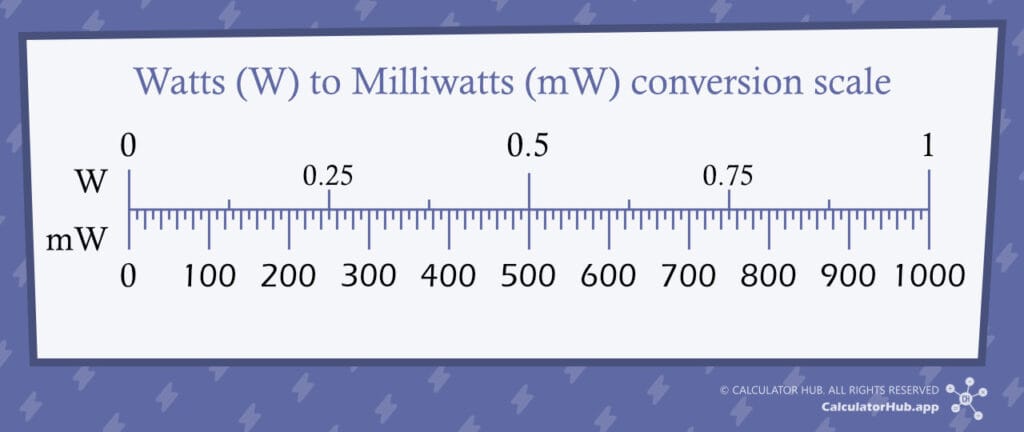
According to SI prefixes[2], which are based on powers of 10, a watt (1 W) is equivalent to one thousand milliwatts (103 mW or 1,000 mW).
It is widely used to quantify electrical, mechanical, and thermal power in everyday applications such as light bulbs, appliances, and motors.
What is a Milliwatt (mW)?
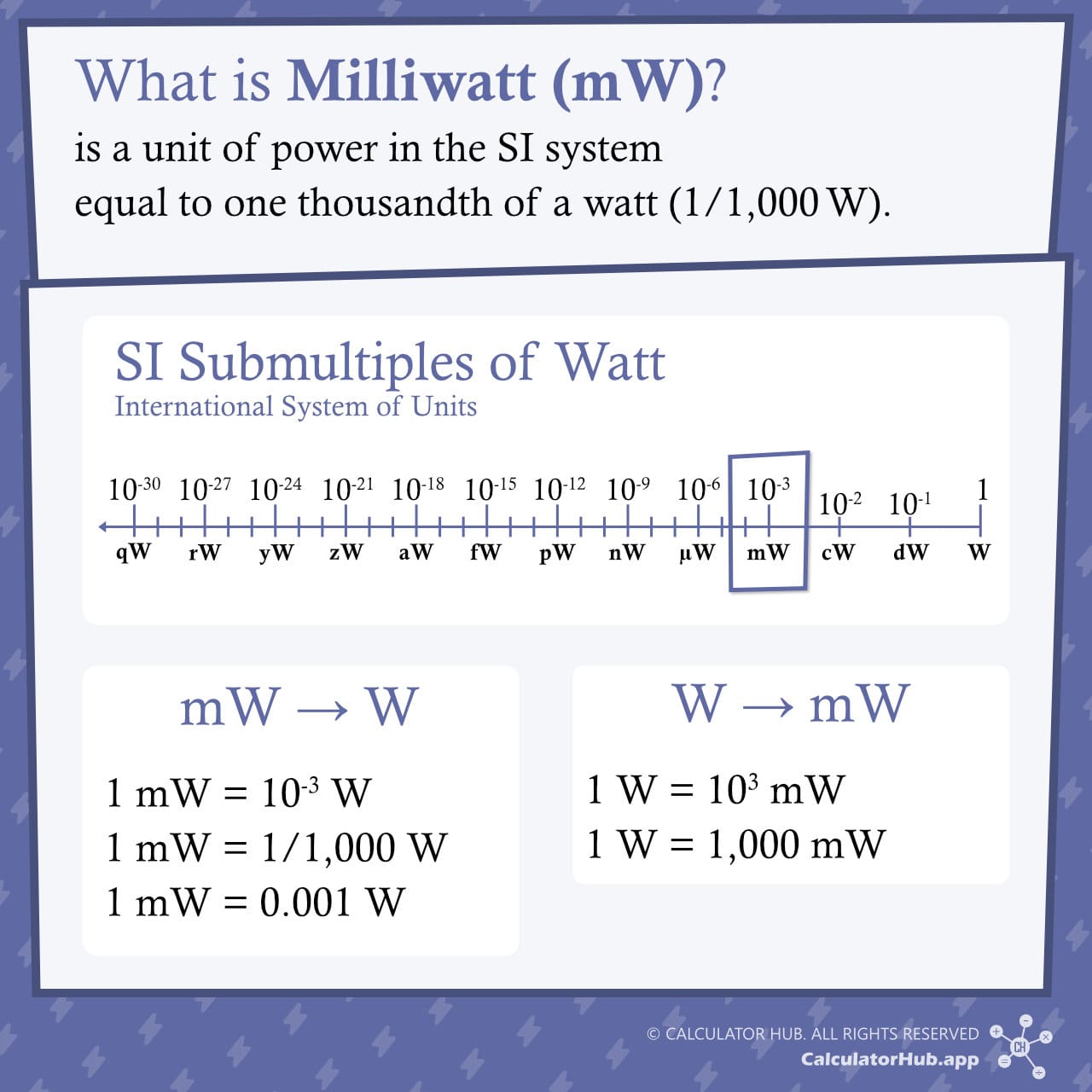
A milliwatt (mW) is a unit of power in the SI system equal to one thousandth (1/1,000) of a watt (0.001 W).
Milliwatts are commonly used to measure small power levels in electronics and communication systems. Devices such as laser pointers, wireless transmitters, hearing aids, and portable audio equipment often operate in the milliwatt range, making this unit ideal for expressing precise, low-power outputs.
W to mW formula
Let’s take a closer look at the conversion formula so you can carry out these conversions independently, whether using a calculator or doing it manually with pencil and paper.
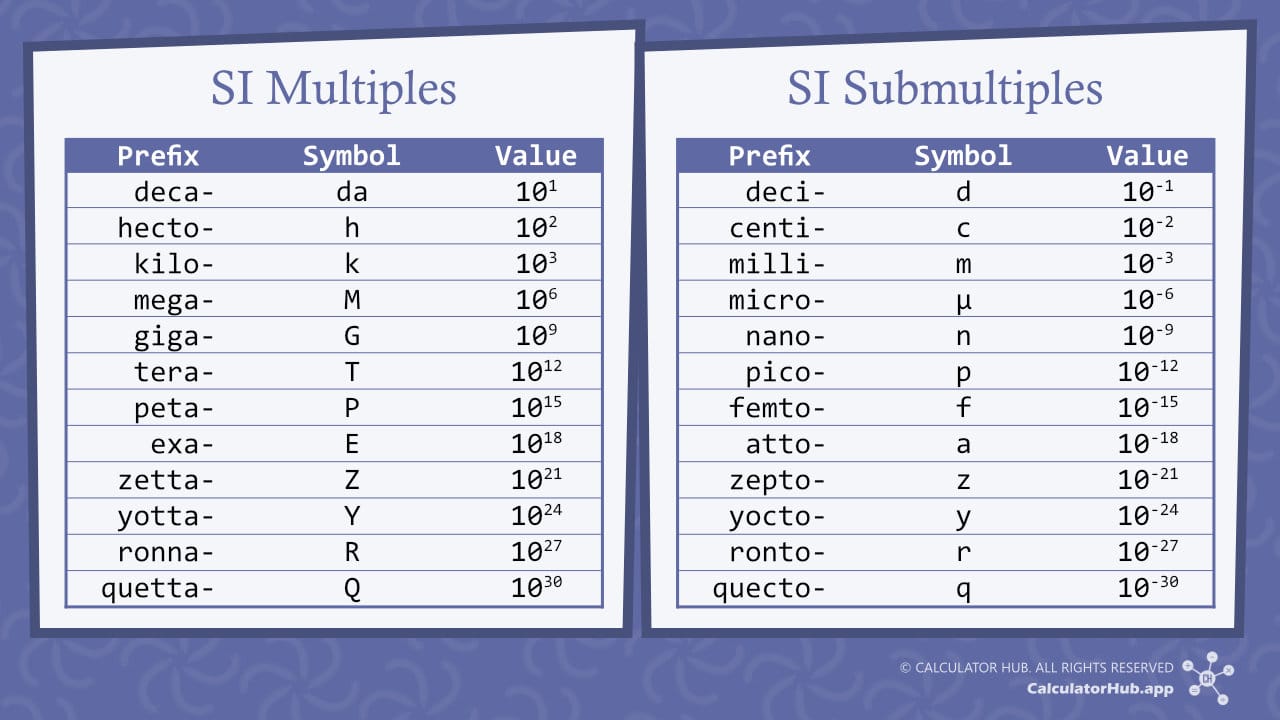
The milli- prefix in the International System of Units (SI) represents a multiplier of 10-3 (0.001). So, to convert from watts to milliwatts, multiply the number of watt (P(W)) by 1,000.
P(mW) = P(W) × 103 = P(W) × 1,000
Or remember the W-to-mW conversion factor: 1 W = 1,000 mW
W to mW conversion table
The conversion table below provides a handy reference for converting power measurement units from watts (W) to milliwatts (mW). It covers commonly available power values, allowing for easy and quick conversions between these units of measurement.
| Watts (W) | Milliwatts (mW) |
|---|---|
| 0.001 W | 1 mW |
| 0.1 W | 100 mW |
| 0.5 W | 500 mW |
| 1 W | 1,000 mW |
| 2 W | 2,000 mW |
| 4 W | 4,000 mW |
| 5 W | 5,000 mW |
| 10 W | 10,000 mW |
| 20 W | 20,000 mW |
| 30 W | 30,000 mW |
| 40 W | 40,000 mW |
| 50 W | 50,000 mW |
| 60 W | 60,000 mW |
| 70 W | 70,000 mW |
| 80 W | 80,000 mW |
| 90 W | 90,000 mW |
| 100 W | 100,000 mW |
| 200 W | 200,000 mW |
| 500 W | 500,000 mW |
| 800 W | 800,000 mW |
| 1,000 W | 1,000,000 mW |
Examples
Now, let's look at an example that illustrates the calculations required to convert from watts to milliwatts (W to mW).
Example: LED Power Rating
Suppose you’re designing a portable LED lamp, and the datasheet specifies a power consumption of 3.5 W. However, your circuit documentation requires power values in milliwatts (mW).
Solution
Since 1 W = 1,000 mW, we can convert 3.5 W to milliwatts by using the following formula:
Therefore, the LED lamp consumes 3,500 mW of power.
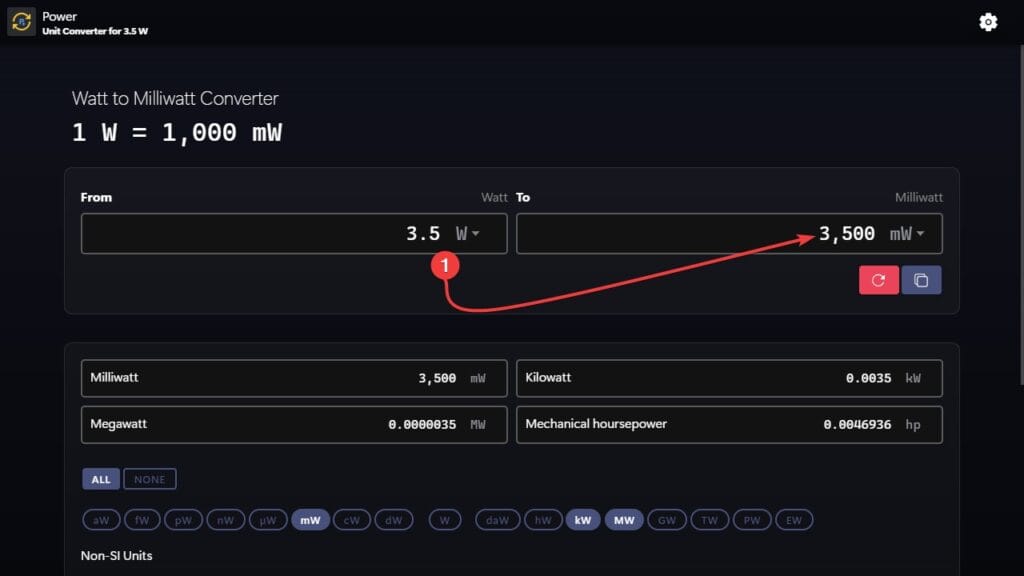
To solve the problem with our calculator, follow the steps below:
- Enter the value in watts: For this example, enter
3.5 Winto theFrombox. - View the result: The converter instantly calculates and displays the equivalent value in milliwatts:
3,500 mW.
FAQs
Is 1 watt or 1 milliwatt larger?
A watt (W) is a thousand times larger than a milliwatt (mW). Here are the relationships between the units:
1 W = 103 = 1,000 mW1 mW = 10-3 = 1 ÷ 1,000 = 0.001 W
How to convert from watts to milliwatts?
To convert power from watts (W) to milliwatts (mW), follow these simple steps:
- Write down the power value in watts (W).
- Multiply it by
1,000. - The result is the power in milliwatts (mW).
Why do I need to convert watts to milliwatts?
Converting watts to milliwatts is essential in electronics and communications where small power levels are common. For example, a Bluetooth transmitter may output 0.005 W, which is clearer to express as 5 mW. This conversion improves readability, simplifies calculations, and aligns with datasheet conventions.
You now know how to convert power units from watts (W) to milliwatts (mW). You can quickly use our calculator to convert between the power measurement units to save time for future calculations.