Accurate power measurements are essential for engineers, electricians, and students working in electrical systems. Whether you are designing motors, analyzing energy efficiency, or comparing mechanical and electrical outputs, understanding how power is expressed and converted helps avoid costly mistakes and ensures optimal performance across diverse applications.
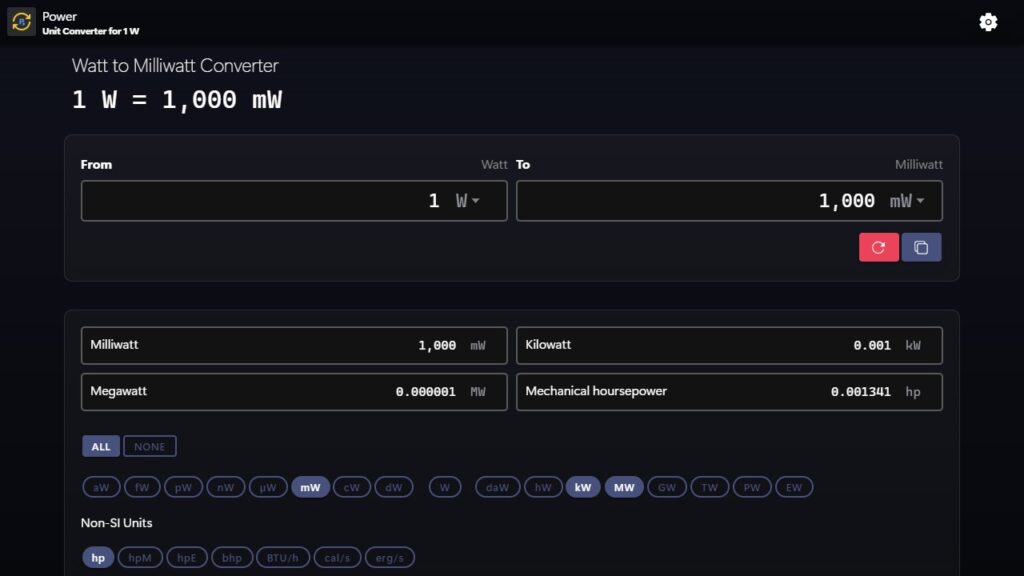
Our power converter interface enables instant and bidirectional power unit conversion. It streamlines the process by facilitating quick conversions between watts, kilowatts, horsepower, and other units. Before diving into conversions, let’s explore the core concepts.
Definitions
Let's begin by clarifying the definitions and differences between power, watts, and horsepower. Understanding these concepts will enable you to perform conversions with confidence.
What is Power?
Power is the rate at which work is done or energy is transferred over time. In electrical systems, it represents how quickly electrical energy is consumed or produced.[1]
Mathematically, power is expressed as:
$$\boxed{P = \frac{W}{t}}$$Where:
Pis power in watts (W)Wis work or energy in joules (J)tis time in seconds (s)
What is Watt?
Watt (W) is the SI derived unit of power, named after James Watt, the Scottish engineer who improved the steam engine. It measures the rate of energy transfer per unit time.[1]
Mathematically 1 W = 1 j/s:
Where:
j = jouleunit of energys = secondunit of time
Thus, one watt equals one joule of energy transferred every second.
What is Horsepower?
Horsepower (hp) is a non-SI unit of power historically developed by James Watt to compare steam engine output to the work of draft horses. It remains widely used in mechanical and automotive contexts.[2]
Horsepower provides a practical measure for engines, motors, and turbines, bridging mechanical and electrical power comparisons.
There are four common types of horsepower, each defined for specific applications.[3]
- Mechanical horsepower: Used in the U.S. for engines and motors. Defined by James Watt as 550 ft·lbf/s.
- Metric horsepower: Used in Europe and Asia. Based on lifting 75 kg over 1 meter in 1 second.
- Electrical horsepower: Used for electric motors. Exactly defined as 746 watts.
- Boiler horsepower: Measures steam boiler output. Based on the energy to evaporate 34.5 lb of water/hr.
Here are their symbols, short symbols (used in our calculator), and their values in watts.
| Type | Symbol | Short | Value (W) |
|---|---|---|---|
| Mechanical horsepower | hp (imperial) | hp | 745.7 W |
| Metric horsepower | PS / cv / hk | hpM | 735.5 W |
| Electrical horsepower | hp (electric) | hpE | 746 W |
| Boiler horsepower | hp (boiler) | bhp | 9,809.5 W |
SI Units of Power
The SI (International System of Units) unit system[4] follows a decimal-based structure, where each unit is a multiple or fraction of 10 (10⁰, 10¹, 10², etc.). The table below lists the standard SI prefixes for watt, along with their symbols, multipliers, and names.
| Submultiples | Multiples | ||||
|---|---|---|---|---|---|
| Value | SI symbol | Name | Value | SI symbol | Name |
| 10−1 W | dW | deciwatt | 101 W | daW | decawatt |
| 10−2 W | cW | centiwatt | 102 W | hW | hectowatt |
| 10−3 W | mW | milliwatt | 103 W | kW | kilowatt |
| 10−6 W | μW | microwatt | 106 W | MW | megawatt |
| 10−9 W | nW | nanowatt | 109 W | GW | gigawatt |
| 10−12 W | pW | picowatt | 1012 W | TW | terawatt |
| 10−15 W | fW | femtowatt | 1015 W | PW | petawatt |
| 10−18 W | aW | attowatt | 1018 W | EW | exawatt |
| 10−21 W | zW | zeptowatt | 1021 W | ZW | zettawatt |
| 10−24 W | yW | yoctowatt | 1024 W | YW | yottawatt |
| 10−27 W | rW | rontowatt | 1027 W | RW | ronnawatt |
| 10−30 W | qW | quectowatt | 1030 W | QW | quettawatt |
These prefixes help simplify electric power measurements across a wide range of applications, from microelectronics to high-power systems.
Non-SI Units of Power
In addition to the watt (W), several non-SI units are used across mechanical, thermal, and historical contexts. These units are standardized for conversion and remain relevant in specific industries such as HVAC, automotive, and thermodynamics.
| Unit Name | Symbol(s) | Value (W) | Description |
|---|---|---|---|
| Mechanical horsepower | hp (imperial) | 745.7 W | U.S. standard for engine output. Defined as 550 ft·lbf/s. |
| Metric horsepower | PS / cv / hk | 735.5 W | Used in Europe and Asia. Based on lifting 75 kg·m/s. |
| Electrical horsepower | hp (electric) | 746 W | Defined exactly as 746 watts for electric motors. |
| Boiler horsepower | bhp | 9,809.5 W | Steam boiler rating. Based on evaporating 34.5 lb of water/hr. |
| Hydraulic horsepower | hp (hydraulic) | ~745.7 W | Power from fluid flow and pressure. |
| BTU per hour | BTU/h | 0.29307107 W | Common in HVAC systems. 1 BTU = heat to raise 1 lb of water by 1°F. |
| Calorie per second | cal/s | 4.1868 W | Used in thermodynamics. 1 cal = 4.1868 J. |
| Kilocalorie per hour | kcal/h | 1.162222 W | Often used in metabolic and heating contexts. |
| Foot-pound per second | ft·lbf/s | 1.3558179 W | British engineering unit. |
| Erg per second | erg/s | 1×10⁻⁷ W | CGS unit of power. 1 erg = 1×10⁻⁷ J. |
Power Unit Conversion Table
The table below provides a quick reference for converting commonly used capacitance units, ranging from farads to picofarads, to help you perform conversions efficiently.
| From | Watt (W) | Milliwatt (mW) | Kilowatt (kW) | Megawatt (MW) | Electrical Horsepower (hpE) | BTU/h | Calorie/s (cal/s) | Erg/s |
|---|---|---|---|---|---|---|---|---|
| 1 W = | 1 W | 1,000 mW | 0.001 kW | 0.000001 MW | 0.00134048 hpE | 3.41214 BTU/h | 0.239006 cal/s | 10,000,000 erg/s |
| 1 mW = | 0.001 W | 1 mW | 0.000001 kW | 0.000000001 MW | 0.00000134048 hpE | 0.003412 BTU/h | 0.000239 cal/s | 10,000 erg/s |
| 1 kW = | 1,000 W | 1,000,000 mW | 1 kW | 0.001 MW | 1.34048 hpE | 3,412.14 BTU/h | 239.006 cal/s | 10,000,000,000 erg/s |
| 1 MW = | 1,000,000 W | 1,000,000,000 mW | 1,000 kW | 1 MW | 1,340.48 hpE | 3,412,140 BTU/h | 239,006 cal/s | 10,000,000,000,000 erg/s |
| 1 hpE = | 746 W | 746,000 mW | 0.746 kW | 0.000746 MW | 1 hpE | 2,547.52 BTU/h | 178.27 cal/s | 7,460,000,000 erg/s |
| 1 BTU/h = | 0.29307107 W | 293.07107 mW | 0.000293 kW | 2.93071×10⁻⁷ MW | 0.000392 hpE | 1 BTU/h | 0.07003 cal/s | 2,930,710 erg/s |
| 1 cal/s = | 4.1868 W | 4,186.8 mW | 0.0041868 kW | 0.00000419 MW | 0.00561 hpE | 14.2857 BTU/h | 1 cal/s | 41,868,000 erg/s |
| 1 erg/s = | 1×10⁻⁷ W | 0.0001 mW | 1×10⁻¹⁰ kW | 1×10⁻¹³ MW | 1.34048×10⁻¹⁰ hpE | 3.412×10⁻⁷ BTU/h | 2.390×10⁻⁸ cal/s | 1 erg/s |
Examples
The following examples demonstrate how to convert between different capacitance units, helping you apply these calculations in practical scenarios.
Example 1: Converting SI Power Units in Solar Panel Design
In solar panel design, engineers often calculate power output in kilowatts (kW) but need to convert it to watts (W) for component-level analysis. Suppose a solar array generates 3.5 kW during peak sunlight. To evaluate inverter compatibility, you must convert this to watts.
Solution
Since 1 kilowatt (kW) = 1,000 watts (W), we can convert 3.5 kW to watt using the following formula:
Therefore, 3.5 kW electric power is equivalent to 3,500 W.
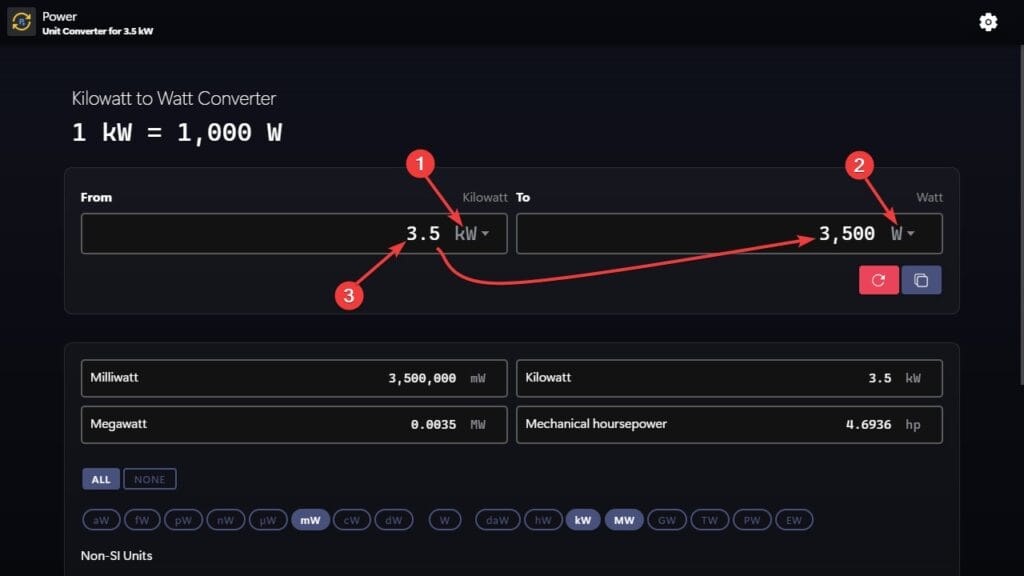
To solve the problem with our calculator, follow the steps below:
- Select the "From" unit: Choose
kW = Kilowattfrom the dropdown menu. - Select the "To" unit: Choose
W = Wattfrom the dropdown menu. - Enter the value in kilowatt: For this example, enter
3.5into theFrombox. - View the result: The converter instantly calculates and displays the equivalent value in watts:
3,500 W.
Example 2: Converting Non-SI Power Units in HVAC System Analysis
In HVAC systems, thermal output is often rated in BTU/h. Suppose a heater is rated at 10,000 BTU/h, and you want to convert this to watts (W) for energy efficiency calculations.
Solution
Since 1 BTU/h = 0.29307107 watts (W), we can convert 10,000 BTU/h to watt using the following formula:
Therefore, 10,000 BTU/h heating power is equivalent to 2,930.71 W.
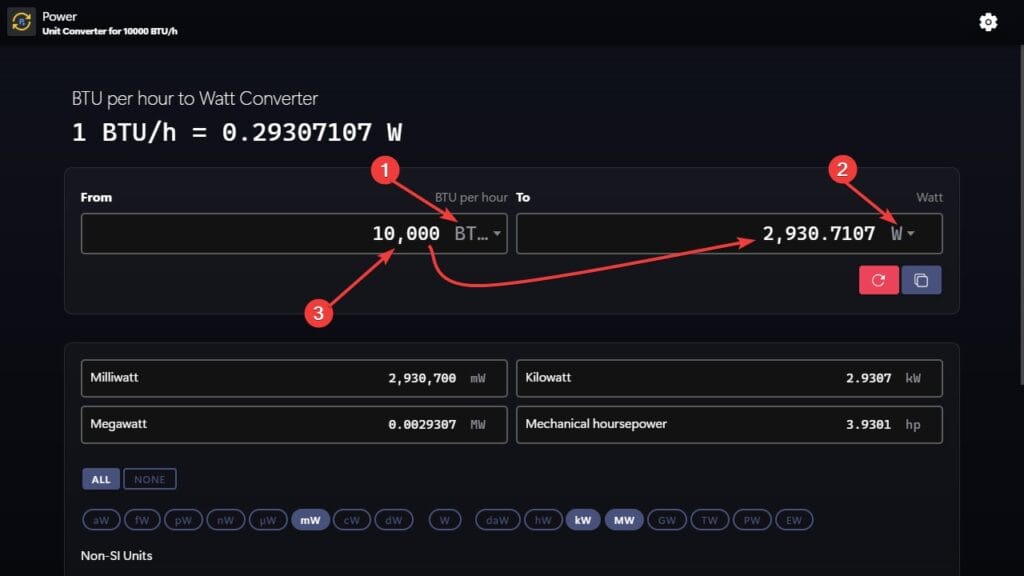
To solve the problem with our calculator, follow the steps below:
- Select the "From" unit: Choose
BTU/h = BTU per hourfrom the dropdown menu. - Select the "To" unit: Choose
W = Wattfrom the dropdown menu. - Enter the value in BTU/h: For this example, enter
10,000into theFrombox. - View the result: The converter instantly calculates and displays the equivalent value in watts:
2,930.7107 W.
You have learned how to convert between power units. You can now efficiently use our calculator to convert power measurement units, saving time on future calculations.