Accurate capacitance measurements are vital for engineers, electricians, and students engaged in the field of electronic circuits. Whether you are designing a power supply, tuning a radio, or analyzing signal behavior, comprehending how capacitors store and release energy can help you avoid costly mistakes and enhance performance across a variety of applications.
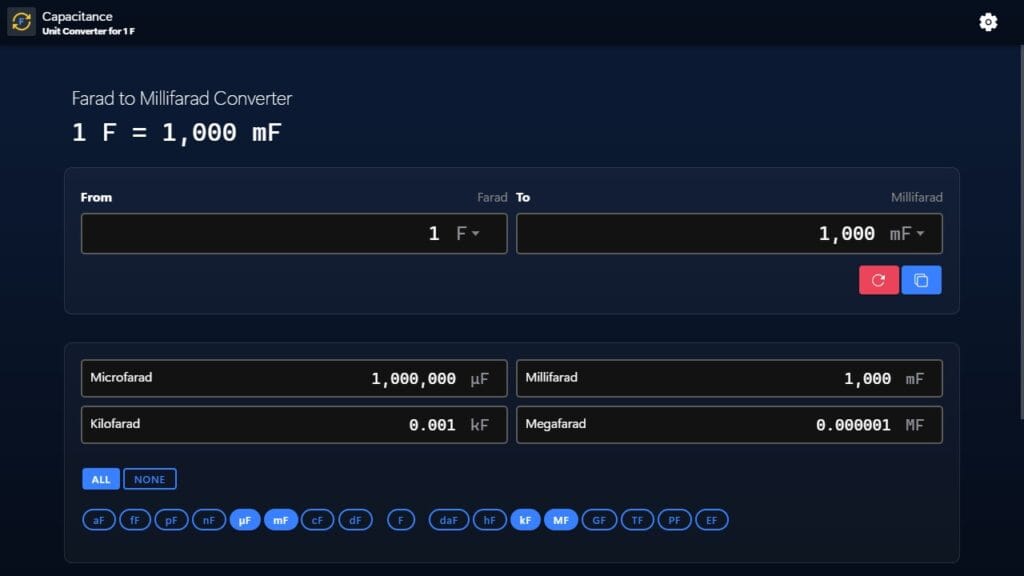
Our capacitance converter streamlines this process by facilitating quick and bidirectional conversions between units such as microfarads, nanofarads, and farads. Before we delve into the conversions, let’s explore the core concepts.
Definitions
Let's begin by clarifying the definitions and differences between a capacitor, capacitance, and a farad. Understanding these concepts will enable you to perform conversions with confidence.
What is a Capacitor?
A capacitor is a passive electrical component that stores energy in the form of an electric field. It consists of two conductive plates separated by an insulating material known as a dielectric.[1]
When voltage is applied across the plates, electric charge builds up, resulting in a positive charge on one plate and a negative charge on the other, which creates a potential difference.
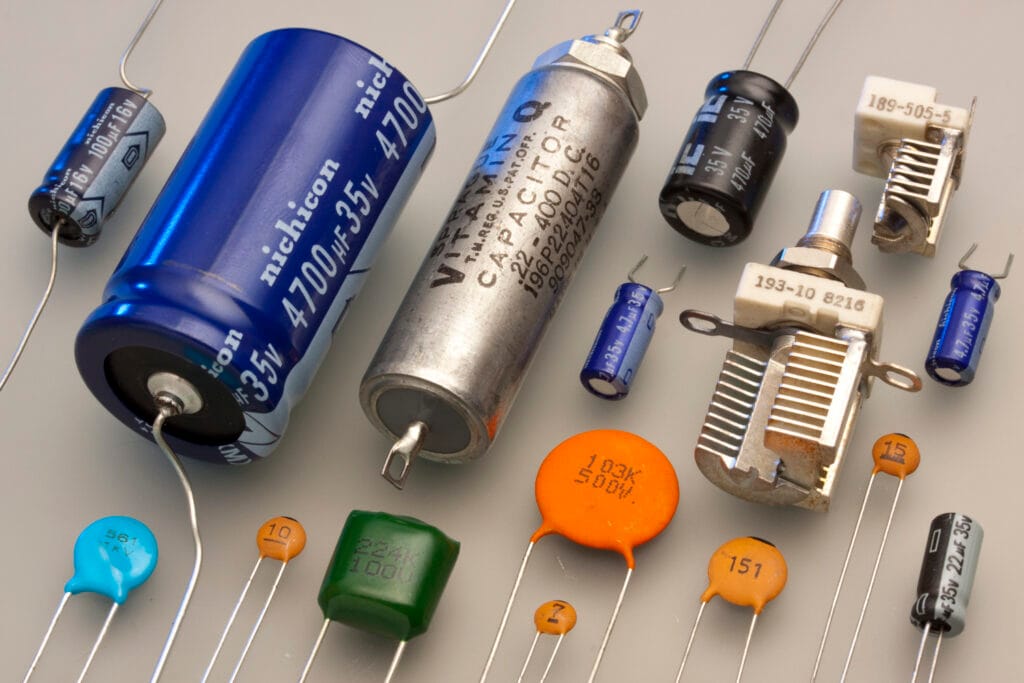
Capacitors are essential components in nearly every electronic device, serving various functions such as smoothing power supply fluctuations and filtering signals in audio equipment. Their ability to store and release energy quickly makes them vital for timing circuits, motor starters, and memory systems.
What is Capacitance?
Capacitance (C) is the measure of how much electric charge (Q) a capacitor can store when a voltage (V) is applied across it.[2]
In most cases, this refers to the ability of a capacitor to hold charge between two conductive surfaces separated by an insulating material. The amount of charge stored depends on the size of the conductive plates, the distance between them, and the properties of the material in between.
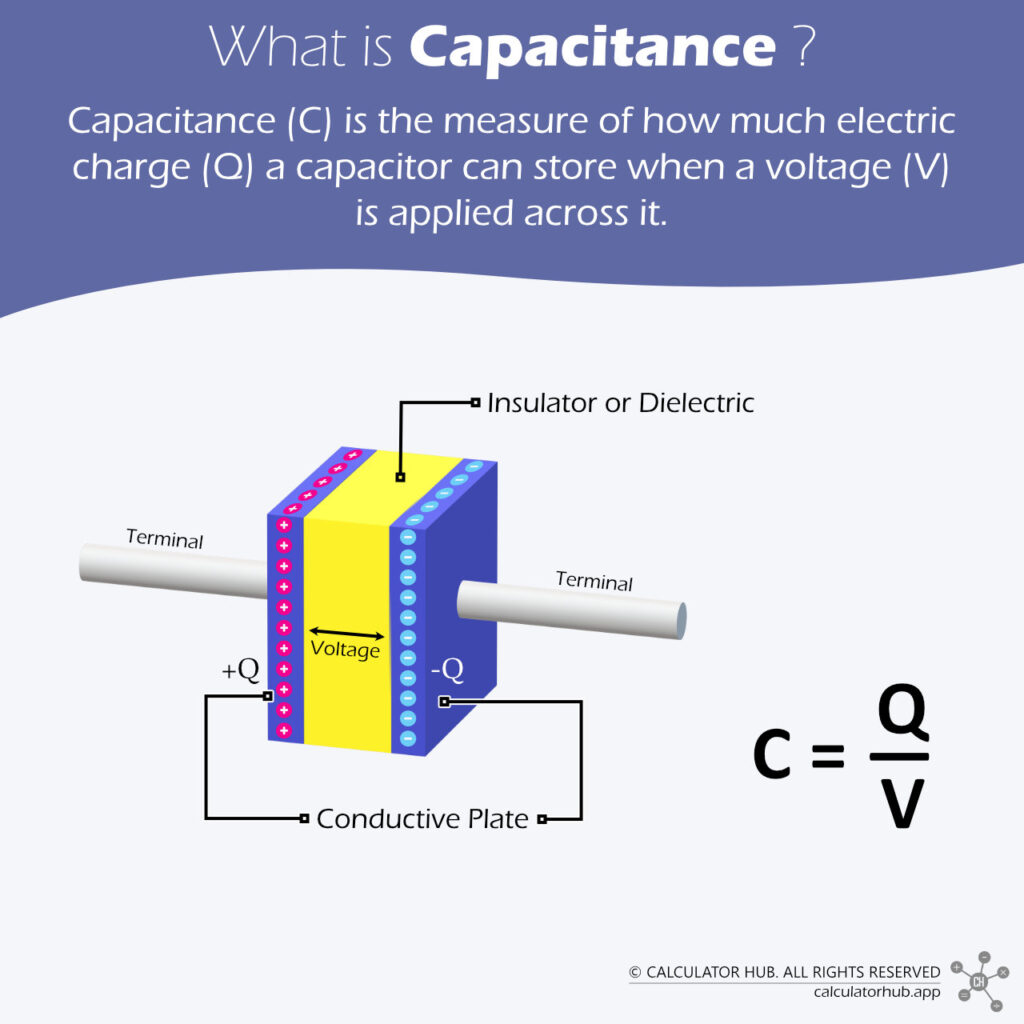
Capacitance C is defined as:
Where:
Cis capacitance in farads (F)Qis electric charge in coulombs (C)Vis voltage in volts (V)
Capacitance depends on the surface area of the plates, the distance between them, and the properties of the dielectric material. Larger plates and closer spacing increase capacitance, while different dielectrics can enhance it further.
What is a Farad?
A farad (1F) is the SI base unit of electrical capacitance representing the capacity to store one coulomb (1C) of electric charge when a potential difference of one volt (1V) is applied.[3]
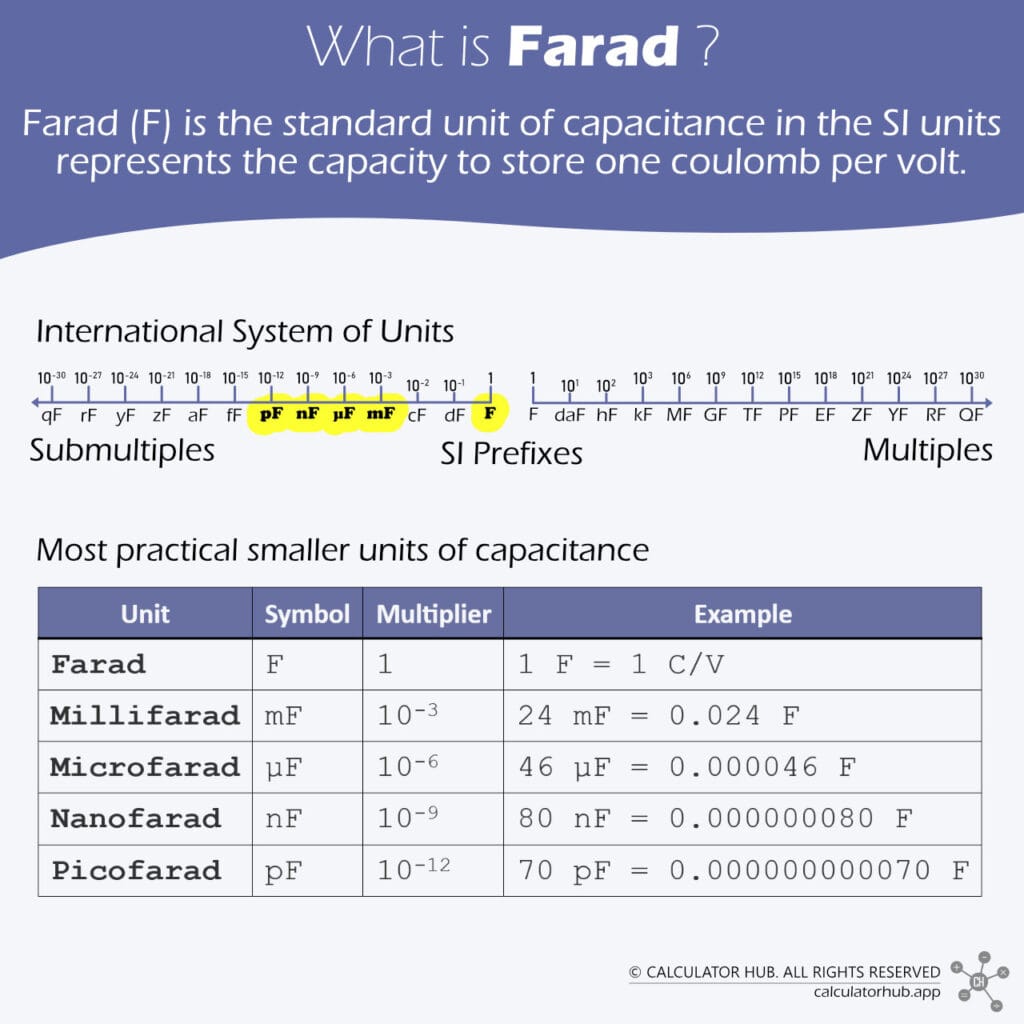
In other words, a capacitor with a capacitance of one farad will hold one coulomb of charge per volt across its terminals (1 F = 1 C/V).
Because one farad is a very large amount of capacitance, most practical applications use smaller units:
| Value | Symbol | Name |
|---|---|---|
| 10-6 | µF | Microfarad |
| 10-9 | nF | Nanofarad |
| 10-12 | pF | Picofarad |
SI Units
The SI (International System of Units) unit system[4] follows a decimal-based structure, where each unit is a multiple or fraction of 10 (10⁰, 10¹, 10², etc.). The table below lists the standard SI prefixes for farads, along with their symbols, multipliers, and names.
| Submultiples | Multiples | ||||
|---|---|---|---|---|---|
| Value | SI symbol | Name | Value | SI symbol | Name |
| 10−1 F | dF | decifarad | 101 F | daF | decafarad |
| 10−2 F | cF | centifarad | 102 F | hF | hectofarad |
| 10−3 F | mF | millifarad | 103 F | kF | kilofarad |
| 10−6 F | μF | microfarad | 106 F | MF | megafarad |
| 10−9 F | nF | nanofarad | 109 F | GF | gigafarad |
| 10−12 F | pF | picofarad | 1012 F | TF | terafarad |
| 10−15 F | fF | femtofarad | 1015 F | PF | petafarad |
| 10−18 F | aF | attofarad | 1018 F | EF | exafarad |
| 10−21 F | zF | zeptofarad | 1021 F | ZF | zettafarad |
| 10−24 F | yF | yoctofarad | 1024 F | YF | yottafarad |
| 10−27 F | rF | rontofarad | 1027 F | RF | ronnafarad |
| 10−30 F | qF | quectofarad | 1030 F | QF | quettafarad |
These prefixes help simplify electrical capacitance measurements across a wide range of applications, from microelectronics to high-power systems.
Conversion table
The table below provides a quick reference for converting commonly used capacitance units, ranging from farads to picofarads, to help you perform conversions efficiently.
| From | Picofarad | Nanofarad | Microfarad | Millifarad | Farad |
|---|---|---|---|---|---|
| 1 farad = | 1,000,000,000,000 pF | 1,000,000,000 nF | 1,000,000 µF | 1,000 mF | 1 F |
| 1 millifarad = | 1,000,000,000 pF | 1,000,000 nF | 1,000 µF | 1 mF | 0.001 F |
| 1 microfarad = | 1,000,000 pF | 1,000 nF | 1 µF | 0.001 mF | 0.000001 F |
| 1 nanofarad = | 1,000 pF | 1 nF | 0.001 µF | 0.000001 mF | 0.000000001 F |
| 1 picofarad = | 1 pF | 0.001 nF | 0.000001 µF | 0.000000001 mF | 0.000000000001 F |
Examples
The following examples demonstrate how to convert between different capacitance units, helping you apply these calculations in practical scenarios.
Example: Audio Equibment
In high-fidelity audio equipment, accurately measuring capacitance is crucial because even small changes can significantly affect sound quality and signal filtering. By converting capacitance values into practical units, audio engineers can detect subtle variations that are vital for optimizing performance and ensuring precision in professional sound systems.
In the latest testing, an audio crossover capacitor has a capacitance of 6,800 nF. Your task is to convert this measurement to microfarads (µF) for better analysis and calibration.
Solution
Since 1 microfarad (µF) = 1,000 nanofarads (nF), we can convert 6,800 nF to µF using the following formula:
Therefore, 6,800 nF is equivalent to 6.8 µF.
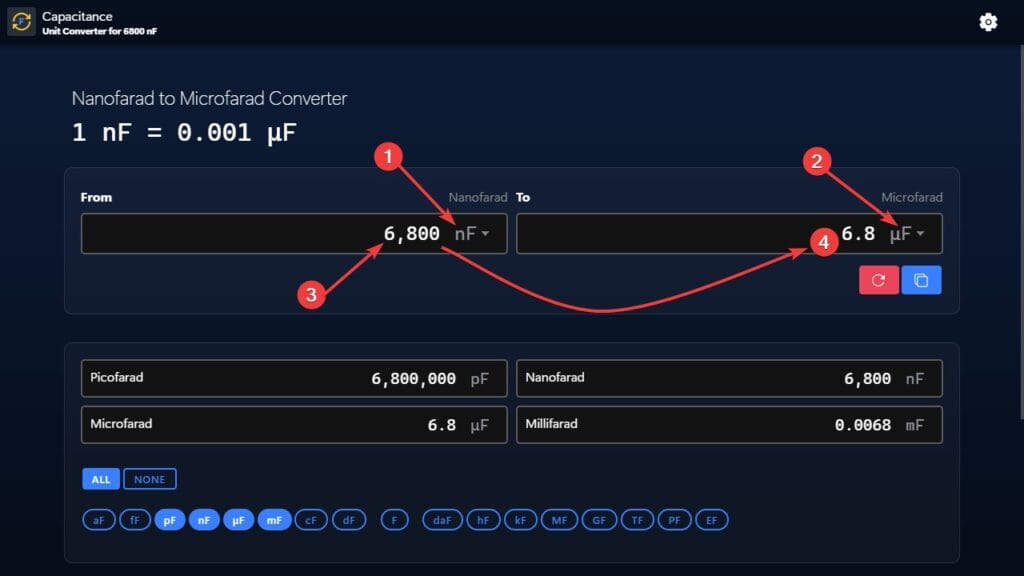
To solve the problem with our calculator, follow the steps below:
- Select the "From" unit: Choose
nF = Nanofaradfrom the dropdown menu. - Select the "To" unit: Choose
µF = Microfaradfrom the dropdown menu. - Enter the value in nanofarads: For this example, enter
6,800into theFrombox. - View the result: The converter instantly calculates and displays the equivalent value in microfarads:
6.8 µF.
You have learned how to convert between electrical capacitance units. You can now efficiently use our calculator to convert capacitance units, saving time on future calculations.