

This article will show how to convert capacitance measurement units from nanofarads (nF) to picofarads (pF). We will cover essential definitions, provide examples, share relevant formulas, and present tables, along with answers to common questions.
Definitions of Farad, Nanofarad, and Picofarad
Let’s get started by understanding the key definitions of Farad (F), Nanofarad (nF), and Picofarad (pF). Understanding these terms will allow you to perform conversions confidently.
What is a Farad?
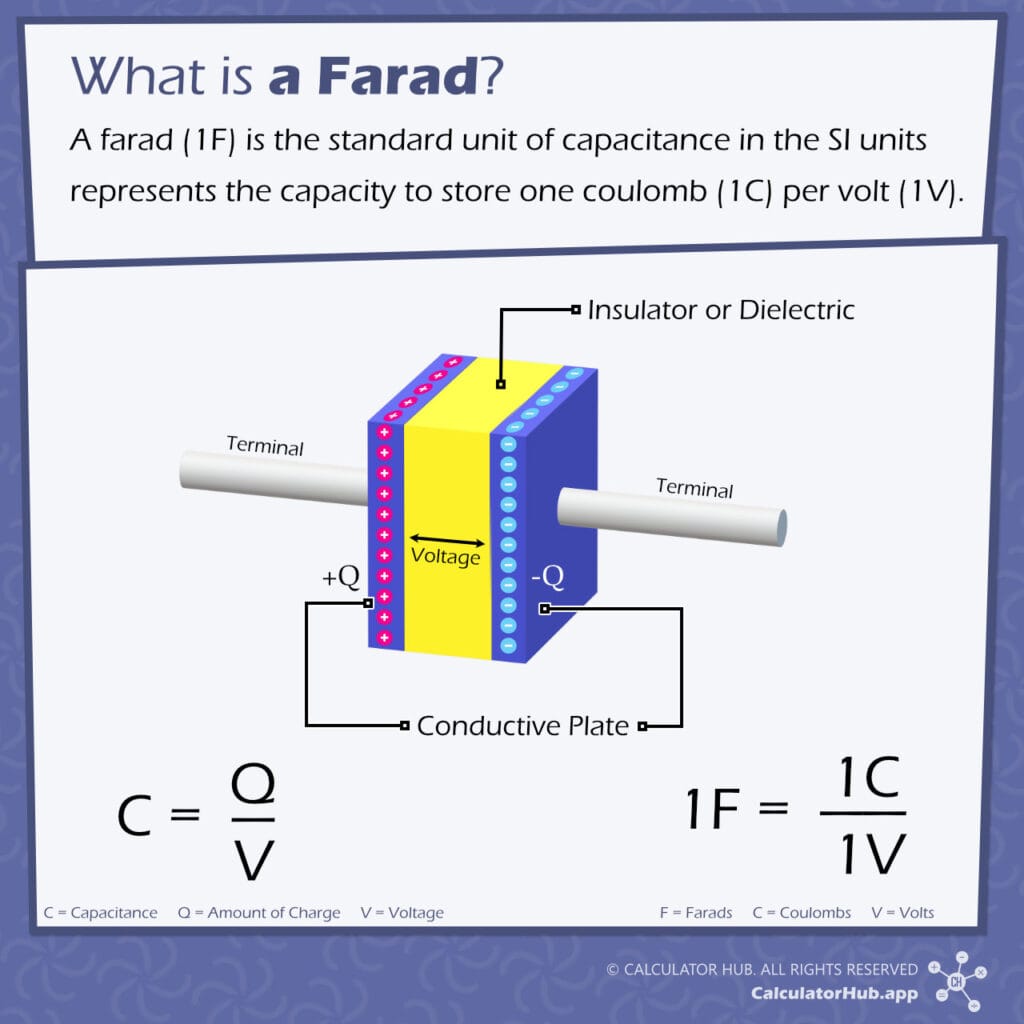
A farad (1F) is the SI base unit of electrical capacitance representing the capacity to store one coulomb (1C) of electric charge when a potential difference of one volt (1V) is applied.[1]
According to SI prefixes[2], which are based on powers of 10, a farad (1 F) is equivalent to one billion nanofarads (1,000,000,000 nF) or one trillion picofarads (1,000,000,000,000 pF).
What is a Nanofarad (nF)?
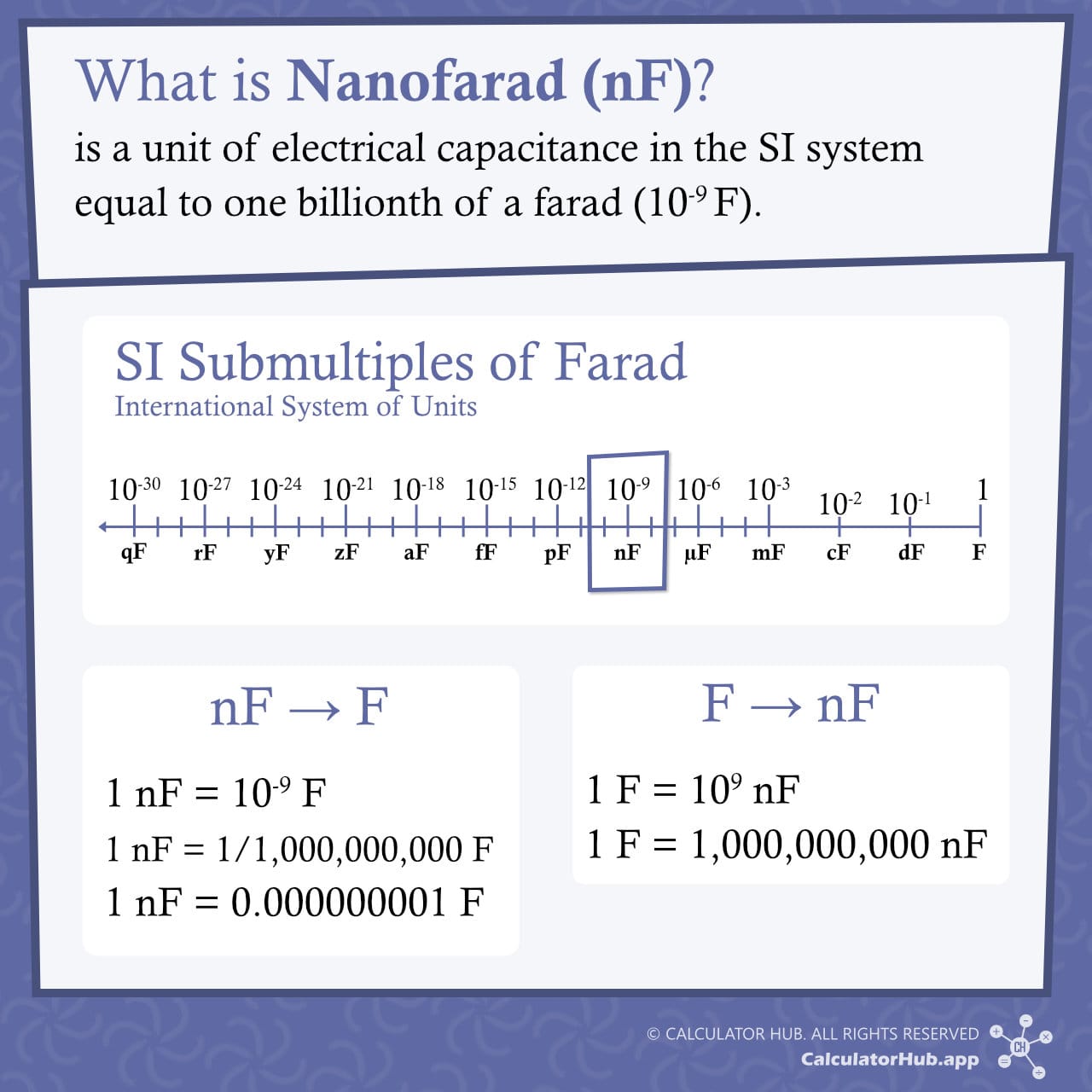
A nanofarad (nF) is a unit of electrical capacitance in the SI system equal to one billionth (1/1,000,000,000) of a farad (0.000000001 F). It is widely used in electronics, especially for capacitors in filters, oscillators, and timing circuits.
What is a Picofarad (pF)?
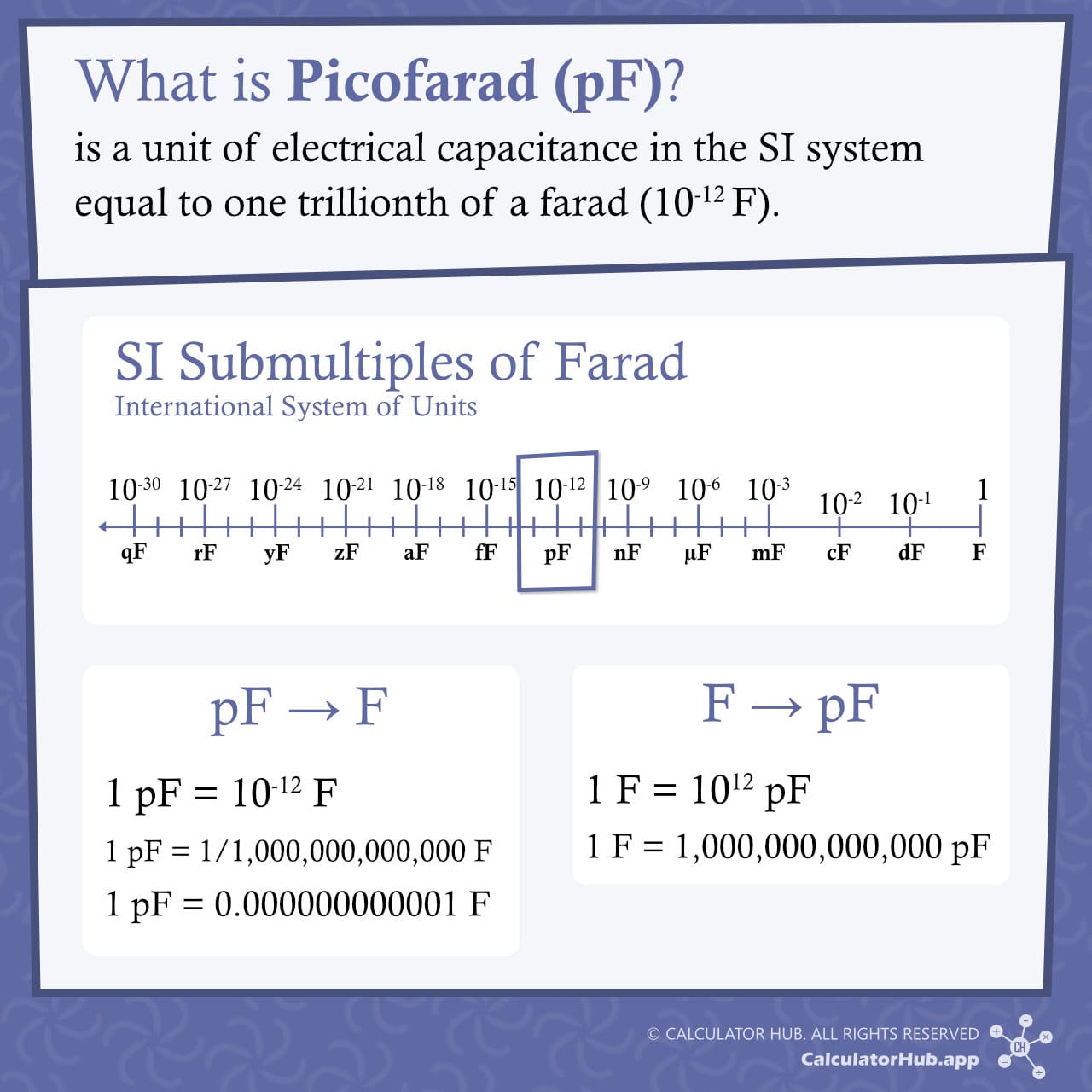
A picofarad (pF) is a unit of electrical capacitance in the SI system equal to one trillionth (1/1,000,000,000,000) of a farad (0.000000000001 F). It is commonly used in RF circuits, oscillators, and high‑speed digital designs where capacitances are very small.
nF to pF formula
Let’s take a closer look at the conversion formula so you can carry out these conversions independently, whether using a calculator or doing it manually with pencil and paper.
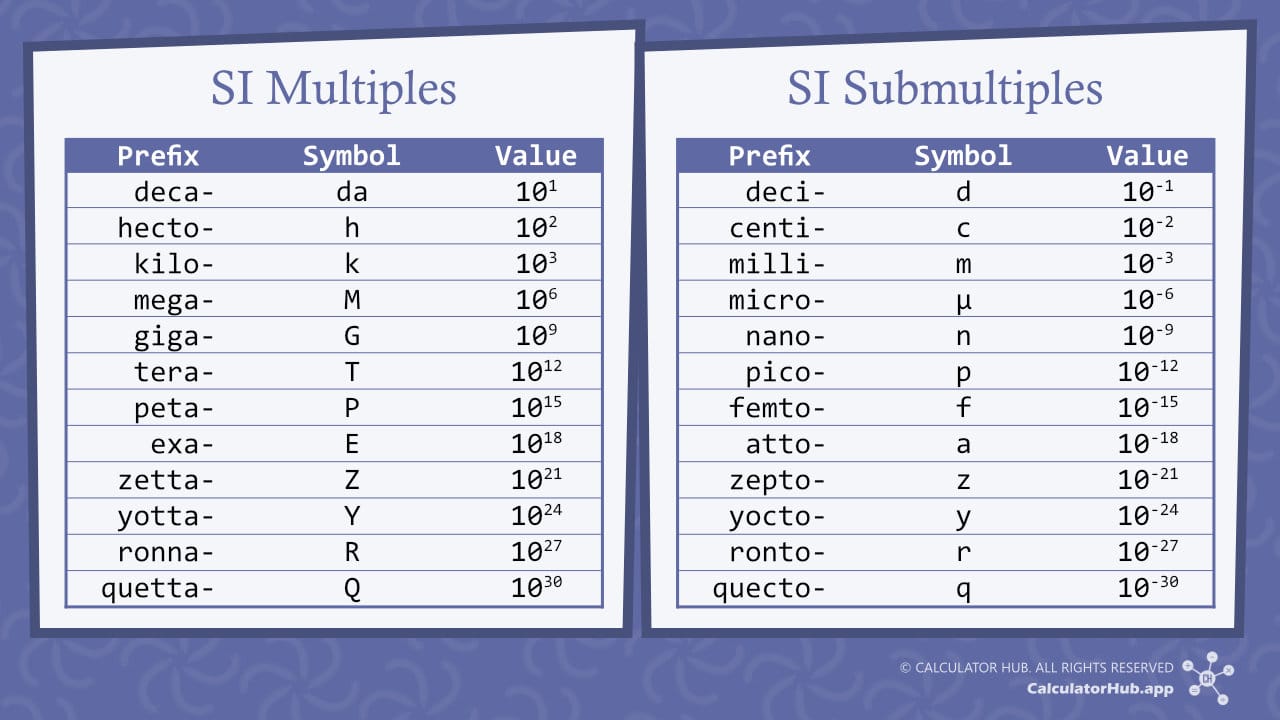
The nano- prefix represents $10^{-9}$, and the pico- prefix represents $10^{-12}$. To convert from nanofarads to picofarads, multiply the number of nanofarads $\text{C}_{\text{(nF)}}$ by 1,000:
C(pF) = C(nF) × 1,000
Or remember the nF-to-pF conversion factor: 1 nF = 1,000 pF
nF to pF conversion table
The conversion table below provides a handy reference for converting electrical capacitance measurement units from nanofarads (nF) to picofarads (pF). It covers commonly available capacitor values, allowing for easy and quick conversions between these units of measurement.
| Nanofarads (nF) | Picofarads (pF) |
|---|---|
| 1 nF | 1,000 pF |
| 10 nF | 10,000 pF |
| 22 nF | 22,000 pF |
| 47 nF | 47,000 pF |
| 100 nF | 100,000 pF |
| 110 nF | 110,000 pF |
| 120 nF | 120,000 pF |
| 130 nF | 130,000 pF |
| 150 nF | 150,000 pF |
| 160 nF | 160,000 pF |
| 180 nF | 180,000 pF |
| 200 nF | 200,000 pF |
| 220 nF | 220,000 pF |
| 240 nF | 240,000 pF |
| 270 nF | 270,000 pF |
| 300 nF | 300,000 pF |
| 330 nF | 330,000 pF |
| 360 nF | 360,000 pF |
| 390 nF | 390,000 pF |
| 430 nF | 430,000 pF |
| 470 nF | 470,000 pF |
| 510 nF | 510,000 pF |
| 560 nF | 560,000 pF |
| 620 nF | 620,000 pF |
| 680 nF | 680,000 pF |
| 750 nF | 750,000 pF |
| 820 nF | 820,000 pF |
| 910 nF | 910,000 pF |
| 1,000 nF | 1,000,000 pF |
Examples
Now, let's look at an example that illustrates the calculations required to convert from nanofarads to picofarads (nF to pF).
Example: Capacitor in RF Oscillator Circuit
Suppose you're designing an RF oscillator and the schematic specifies a capacitor of 47 nF. However, your simulation software requires the value in picofarads to calculate frequency stability.
Solution
Since 1 nanofarad (nF) = 103 = 1,000 picofarads (pF), we can convert 47 nF to picofarads by using the following formula:
Therefore, the 47 nF electrical capacitance is equivalent to 47,000 pF.
To solve the problem with our calculator, follow the steps below:
- Enter the value in nanofarads: For this example, enter
47into theFrombox. - View the result: The converter instantly calculates and displays the equivalent value in picofarads:
47,000 pF.

FAQs
Is a nanofarad or a picofarad larger?
A nanofarad (nF) is a thousand times bigger than a picofarad (pF). Here are the relationships between the units:
1 nF = 103 = 1,000 pF1 pF = 10-3 = 1 ÷ 1,000 = 0.001 nF
How to convert from nanofarads to picofarads?
To convert electrical capacitance from nanofarads (nF) to picofarads (pF), follow these simple steps:
- Write down the capacitance value in nanofarads (nF).
- Multiply it by 1,000.
- The result is the capacitance in picofarads (pF).
Why is it necessary to convert nanofarads to picofarads?
Precision in high‑frequency circuit design In RF and microwave applications, capacitance values are often extremely small, and engineers typically work in picofarads (pF) rather than nanofarads (nF).
For example, tuning a resonant circuit or matching impedance in an antenna design may require adjustments of just a few picofarads. Converting from nF to pF ensures you express values in the finer unit scale that matches the precision required for high‑frequency calculations, simulations, and component selection.
You now know how to convert electrical capacitance from nanofarads (nF) to picofarads (pF). You can quickly use our calculator to convert between the electrical capacitance measurement units to save time for future calculations.